October 20, 2026
Registry vs Intiqal in Pakistan, Key Differences
Registry vs Intiqal in Pakistan, Key Differences...
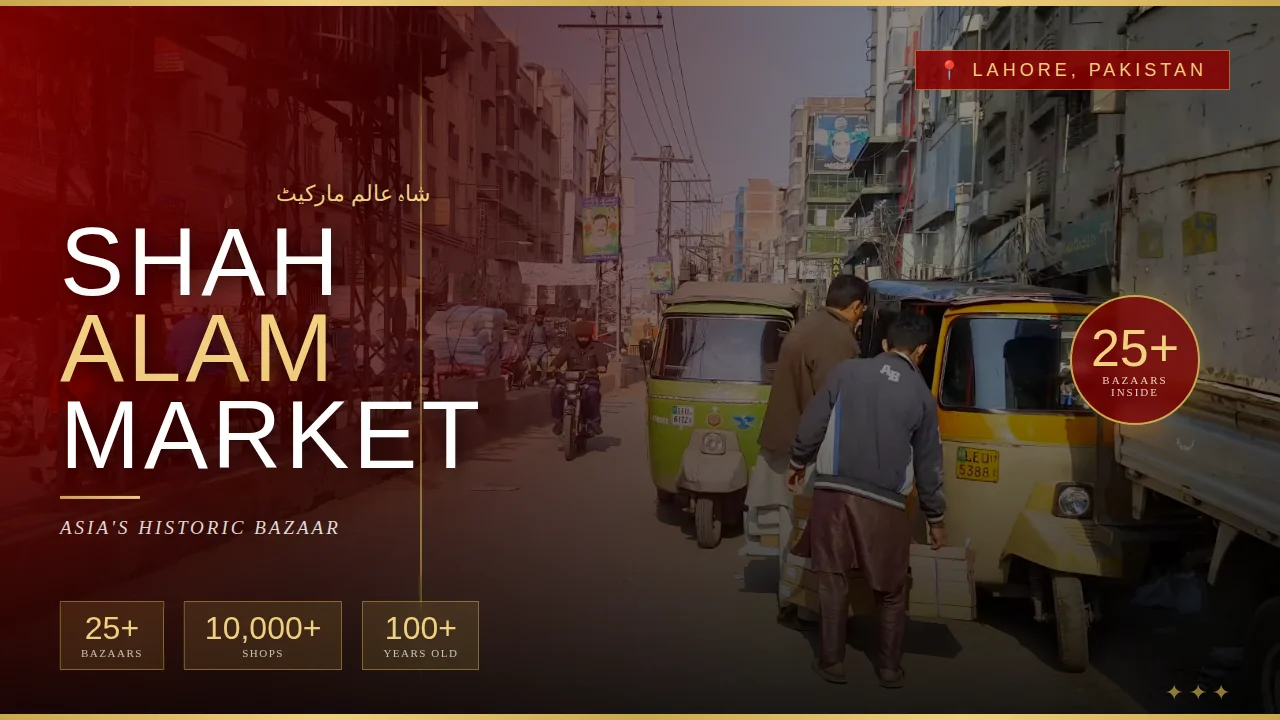
Walk into Shah Alam Market and you walk into a world that has been trading, hustling, and supplying Pakistan for over a century. Known by many names Shahalami, Shahalmi, Shalmi, Shah Alami, this vast wholesale and retail complex in the heart of Lahore's Walled City is one of Pakistan's largest and most historically significant commercial markets. It is the place where retailers from across Punjab come to source inventory, where entrepreneurs begin their businesses, and where the sheer density and variety of goods on offer is unlike anything found in any modern mall or plaza.
This complete guide covers everything about Shah Alam Market Lahore: its Mughal-era history, the story of its gate and its destruction during Partition, all its famous sub-markets, what to buy in every category, how to navigate its 25+ bazaars, the best times to visit, and why it remains irreplaceable in Pakistan's commercial landscape.
Detail | Information |
|---|---|
Common Names | Shah Alam Market, Shahalami, Shahalmi, Shah Alami, Shalmi Market |
Location | Shah Alami Road, Walled City, Lahore |
Size | Over 25 individual bazaars within the complex |
Market Type | Wholesale + Retail |
Timings | Daily 9:00 AM – 9:00 PM |
Best For | Wholesale textiles, clothing, cosmetics, jewellery, accessories, household goods |
Famous Sub-Markets | Pappar Mandi, Sarafa Bazaar, Rang Mahal, Bottle Bazaar, Kinaari Bazaar, Wacho Wali Bazaar, Ainak Market |
Historical Identity | Named after Mughal Emperor Shah Alam I, son of Aurangzeb |
Gate Status | Shah Almi Gate burned in 1947 Partition riots — only the name survives |
Entry Fee | Free |
Shah Alam Market takes its name from the Shah-Almi Gate of the Walled City of Lahore — one of the twelve historic gates of old Lahore. The gate was named after Mughal Emperor Shah Alam I, the son of Emperor Aurangzeb. Prior to the emperor's death, this gate was known as the Bherwala Gate. The area surrounding the gate became one of the most commercially active zones of the Walled City over the centuries.
Shah Alam Road itself was named after the third last Mughal Emperor. The road begins near the grave of Malik Ayaz — the first Muslim Governor of Lahore — and connects Rang Mahal Chowk with the Bansaan Wala Bazaar, dividing the old city roughly into its eastern and western halves.
Before 1947, Shah Alami was mostly a Hindu-populated area with businesses owned by Hindus. This was true of much of the Walled City's commercial districts — Hindu merchants, traders, and bankers had built and operated many of the most prosperous businesses in these lanes for generations.
A visible reminder of this history still stands in the area: a half-burnt building between Shah Alam and Rang Mahal bearing the inscription "Gobind Ram Kahan" and "Hindustan Commercial Bank Established 1805." This building — the only one to survive the violence of 1947 in the immediate area — was intended to house a Lahore branch of the Hindustan Commercial Bank, one of the oldest banks in the subcontinent. The branch never opened. The building remains as a silent witness to the commercial world that once was.
The Partition of 1947 was devastating for Shah Alami. During the 1947 partition riots, the Shah Almi Gate was burned. Today only the name survives. Several areas and sections of this market had been gutted in fires during communal violence in the middle of August 1947. During the 1947 partition, most of the Hindus were forced to migrate to India.
After partition, Shah Alam Market was rebuilt or renovated as the only double-tracked road within the Walled City. Muslim traders took over the businesses and built Shah Alam into the commercial powerhouse it is today. The market has served as a bustling hub of commerce for more than a century, maintaining its vibrancy day by day.
The Shahalmi team describes themselves as a group of third-generation traders who came to the Walled City of Lahore more than a century ago to become part of Shah Alam Market, famous for wholesale commerce. This generational continuity is part of what makes the market special — many of today's traders are the grandchildren and great-grandchildren of the merchants who rebuilt this market after Partition.
Today, Shah Alam Market is Pakistan's largest wholesale and retail market. The value of individual shops within the market — some of which are as tiny as 8x8 feet — can reach PKR 50–60 million, reflecting the extraordinary commercial premium attached to a trading spot in this ancient marketplace.
Address: Shah Alami Road, Walled City, Lahore, Punjab 54000
Shah Alam Market is located in the heart of the Walled City of Lahore, accessible from multiple gates including Shah Alam Gate (site), Lohari Gate, and Rang Mahal Chowk. The market connects Rang Mahal Chowk to the Circular Road via Bansaan Wala Bazaar, running roughly east-west through the old city.
On foot from Anarkali Bazaar: One of the most rewarding ways to reach Shah Alam Market is on foot from Anarkali Bazaar — a 10–15 minute walk through the historic lanes of the Walled City that takes you past Urdu Bazaar and into the beating commercial heart of old Lahore.
By rickshaw from Mall Road: The quickest and most practical option for most visitors. Rickshaws from Mall Road, Anarkali, or the Circular Road reach the market in 10–15 minutes.
By Orange Line Metro: The nearest Orange Line station is in the Lakshmi Chowk area. From there, a short rickshaw ride reaches the Walled City entrances near Shah Alam Market.
By car: Driving into Shah Alam Market is strongly discouraged — the lanes are extremely narrow, parking is virtually non-existent, and congestion is a persistent challenge. Park near Mall Road or the Circular Road and walk or take a rickshaw into the market.
The interconnected market network: An important feature of the Walled City's markets is how they connect to each other. If you reach Kashmiri Bazaar it will take you to Kasera Bazaar from where you can go to Sarafa Bazar and then Rang Mahal and finally Shah Almi. It is an interesting maze — first-time visitors are advised to either come with a local guide or allow ample time for exploration.
Shah Alam Market operates daily from approximately 9:00 AM to 9:00 PM.
Time | Experience |
|---|---|
9:00 AM – 11:00 AM | Best for wholesale buyers — market fully stocked, trade-focused atmosphere |
11:00 AM – 3:00 PM | Peak wholesale trading hours — maximum activity |
3:00 PM – 7:00 PM | Mixed wholesale and retail — vibrant but crowded |
7:00 PM – 9:00 PM | Evening retail rush — colourful atmosphere, busy lanes |
Weekday mornings | Optimal for wholesale purchasing — traders at full capacity |
Weekends | More retail shoppers — livelier but more congested |
Shah Alam Market is not a single market, it is a vast network of over 25 individual bazaars, each with its own speciality, its own history, and its own distinct character. Here is a complete guide to the most important ones:
Location: Between Shah Alam Gate and Lohari Gate Shops: Approximately 275 Age: Over 100 years — predates Pakistan's formation
Pappar Mandi is one of the most historically fascinating and aromatic sub-markets within Shah Alam Market. The name "Pappar" refers to crackers or flatbreads, though today the market is known for herbs, traditional perfumes (attars), jams and preserves (murabbajaat), and plastic bottles. Its narrow width — just five to seven feet — is lined with two- to three-storey buildings on both sides, with shops on the ground floor and homes above.
Adam Perfumery in Pappar Mandi has been selling perfumes for over three decades and is one of the market's most celebrated fragrance destinations. The dense, layered aroma of attars, herbs, and spices that fills Pappar Mandi's lanes is unlike anything else in Lahore.
What to buy: Herbal medicines, traditional attars and perfumes, murabbajaat (jams and preserves), plastic bottles, packaging materials.
Location: Within Shah Alam Market, connected to Rang Mahal Age: Over a century
Sarafa Bazaar is the gold jewellery trading hub of Shah Alam Market and one of Lahore's most important precious metals markets. The word "sarafa" literally means "money changer" or "goldsmith" in Urdu/Punjabi — reflecting the market's centuries-old identity as a centre for gold and silver trading. Sarafa Bazaar connects directly to Rang Mahal Chowk and has historically been the first stop for gold buyers, jewellers restocking inventory, and bridal families sourcing gold sets at trade prices.
What to buy: Gold jewellery, silver items, bridal sets, gold bars and coins, jewellery-making raw materials.
Location: Rang Mahal Chowk, central Walled City History: Mughal era origins
Rang Mahal — literally "Colourful Palace" — is one of the most historically resonant names in the Walled City. Dating back to the Mughal era, this area emerged as a vibrant centre of trade and craftsmanship. The market sits at a central chowk that connects multiple bazaars and serves as one of the principal navigation landmarks within the Walled City's commercial labyrinth.
Rang Mahal is known for its textile market, gold jewellery, bridal embroidered shawls, traditional fabrics, and handicrafts. The chowk itself is surrounded by buildings that carry visible traces of pre-Partition history — including the half-burnt Hindustan Commercial Bank building.
What to buy: Textiles, fabrics, bridal embroidered shawls, gold jewellery, traditional crafts, decorative items.
One of the more unusual but commercially significant sub-markets within Shah Alam is the Bottle Bazaar — a dedicated market for glass and plastic bottles, jars, containers, and packaging materials of every variety. This market serves the pharmaceutical industry, food processing businesses, cosmetics manufacturers, and any enterprise that requires packaging at bulk prices.
What to buy: Glass bottles, plastic containers, jars, spray bottles, packaging materials, industrial containers.
Location: Inside Shah Alam Gate Age: Over 100 years
Kinaari Bazaar, situated inside Shah Alam Gate, has existed for more than 100 years. Before Partition most of the shops here belonged to Hindus and Sikhs, but after Partition they migrated to India. Currently approximately 150 shops operate here. Kinaari Bazaar is famous for all kinds of embroidered cloth for weddings and festivals. Embroidery cloth is supplied from here to all the large markets of the city and to other cities across Pakistan.
What to buy: Embroidered fabric, bridal dupattas, gota, lace, ribbon, lace trim, wedding fabric accessories.
Location: Near Rang Mahal Chowk, at the conclusion of Sarafa Bazaar Shops: Approximately 400 Age: Pre-Partition
Wacho Wali Bazaar is a diverse marketplace encompassing both silver jewellery and shoe raw materials. At the beginning of the bazaar, around 10–15 shops specialise in silver items. Following these are shops selling raw materials for shoes — Rexine sheets, beads, decorative stones, and shoe design components. This unusual combination reflects the organic, unplanned way in which the Walled City's markets evolved over centuries.
What to buy: Silver jewellery, Rexine (faux leather) sheets, shoe beads and decorative components, shoe-making raw materials.
Location: Outside Shah Alam Gate Operating since: 1972 Shops: 340
The Ainak Market is a unique wholesale and retail market dedicated entirely to eyewear — sunglasses, eyeglass frames, and lenses. With 340 shops and surrounding factories and warehouses manufacturing or storing frames, the Ainak Market is the primary sourcing point for eyewear retailers across Punjab. Products range in price from PKR 350 to PKR 10,000, catering to every budget from street vendors to optical shops.
What to buy: Sunglasses, prescription eyeglass frames, lenses, optical accessories.
Location: Adjacent to Kinaari Bazaar, inside Shah Alam Gate Age: Post-2000 (clothing section)
Gumti Bazaar, adjacent to Kinaari Bazaar, is one of Lahore's oldest marketplace locations. Its clothing section is more recent, emerging after Kinaari Bazaar could not accommodate more shops. Visitors find a comprehensive range of bridal dresses, typically featuring shops specialising in unstitched garments, which are more affordable, including some with minor defects sold at discounted prices.
What to buy: Bridal dresses, unstitched fabric, occasion wear at budget prices.
I now have all the information needed from the official Walled City Lahore Authority website. Here is the complete updated document with all bazaars added:
Location: Near Rang Mahal Chowk | Shops: Approximately 100 | Age: Over 135 years
Kasera Bazaar was established nearly 135 years back and is famous for household utensils and crockery. From tableware to all types of cooking utensils, a huge variety can be found here. The items are mostly made of iron, steel, brass, and copper.
Inside Kasera Bazaar there are also antique crockery and decoration pieces — chandeliers, lamps, wall hangings, and vases that are unlike anything found in modern markets. The bazaar attracts foreign tourists and exports souvenirs from Lahore's rich craft heritage. Traditionally, copper and brass polishers (kalayee wala) were found here on every corner, though today only one such craftsman remains — a poignant reminder of how culture evolves.
What to buy: Household utensils, crockery, brass and copper items, antique décor pieces, chandeliers, lamps, souvenirs.
Location: Walled City, near Delhi Gate | Age: Mughal era
Akbari Mandi is the wholesale market of grains, spices, herbs, and chemicals, claimed as one of the largest spice and grain markets in Asia. The market is named after Mughal Emperor Akbar the Great and is said to date from his era, giving it deep historical importance.
This is the primary sourcing hub for spice traders, food processors, and herbal medicine dealers across Pakistan and beyond. The scale and variety of produce on offer — from exotic spices to industrial chemicals — is staggering.
What to buy: Wholesale grains, spices, herbs, dried fruits, chemicals, food-grade raw materials.
Location: Inside Delhi Gate | Age: Over 60 years (current location since 1953)
Azam Cloth Market, situated within Delhi Gate, stands as the largest wholesale cloth market in Asia. It serves as a vital supplier of cloth to Afghanistan, Iran, India, and China, boasting a vast network of over 25,000 shops. This market forms a labyrinth of interconnected bazaars, often shrouded from direct sunlight, exuding a lingering scent of history.
Originally, in 1953, a small market near Wazir Khan Mosque was relocated to its present site by General Azam — after whom the market is now named — to accommodate a road-widening project. Today it offers everything from khaddar to silk, and from ready-to-wear to bridal wear.
What to buy: All varieties of wholesale fabric — cotton, silk, khaddar, chiffon, bridal fabric, printed cloth, and linen.
Location: Alongside Azam Cloth Market | Age: Approximately 40 years | Shops: Around 2,000
The Pakistan Cloth Market operates alongside the Azam Cloth Market but specialises in retail clothing, gaining widespread popularity among the residents of Lahore and beyond. Although relatively newer compared to the Azam Cloth Market, it was established around 40 years ago and houses approximately 2,000 shops.
Where Azam Cloth Market is the choice of wholesale traders, Pakistan Cloth Market is the go-to destination for individual shoppers looking for fabrics at accessible retail prices.
What to buy: Retail fabrics, ready-to-wear clothing, occasion wear, seasonal fabrics.
Location: Rear of Soneri Masjid, adjacent to Kasera Bazaar | Shops: Approximately 50 | Age: Over 135 years
The Loha Market comprises around 50 shops and has been running parallel to Kasera Bazaar for 135 years. Here, various iron household items apart from utensils are available for sale, including locks, keys, wires, iron pipes or rods, iron nets, and numerous other products.
This is an essential market for builders, craftsmen, and hardware retailers sourcing iron goods at wholesale prices.
What to buy: Locks, keys, iron pipes, rods, wires, iron nets, iron grills, hardware supplies.
Location: Near Rang Mahal Chowk, adjacent to Kasera Bazaar | Shops: Approximately 45 | Age: Over 125 years
Waan Market has been in existence for 125 years. Prior to partition, it was known as Bazar Waan Wattan. This market specialises in Baan, Seba, plastic baan, and all kinds of materials used in crafting traditional beds. Additionally, it offers traditional Peerhay, chokies, and chabian. Visitors can witness artisans skillfully crafting furniture using the Waan material, providing an intriguing glimpse into their craftsmanship.
What to buy: Baan (woven rope) for traditional charpoy beds, Peerhay (low stools), chokies, furniture weaving materials.
Location: Walled City | Shops: Approximately 1,200 | Age: Mughal era
Moti Bazaar is the wholesale shoe market of the Walled City. From here, shoes are supplied across the entire country and are also exported to other countries. The name of this bazaar is said to have been famous since the Mughal period. Nearly 1,200 shops are here.
With over a thousand shops, Moti Bazaar is one of the largest footwear markets in Pakistan, supplying retailers nationwide with every style of shoe imaginable.
What to buy: Wholesale shoes, sandals, formal footwear, casual footwear, children's shoes.
Location: Between Shah Alam Gate and Lohari Gate | Shops: Approximately 55 | Age: About 30 years (current form)
Before partition there were some traders of gem stones here, but after partition they all migrated to India. The present gem stone market was established some 30 years ago and there are almost 55 shops.
Despite its relatively recent re-establishment, the Gem Stone Market draws jewellers, collectors, and traders from across Pakistan looking for rubies, emeralds, sapphires, and a wide range of semi-precious stones.
What to buy: Rubies, emeralds, sapphires, turquoise, lapis lazuli, agate, and other precious and semi-precious stones.
Location: Inside Taxali Gate | Shops: 120 | Age: Mughal era
Located within Taxali Gate, the Sheikhupurian Bazaar is a relic of the Mughal era, named after Shehzada Saleem, affectionately known as Sheikhu. This market is celebrated for its exquisite leather Khussas and Kolhapuri chappals, catering to both wholesale and retail needs. The Khussas and Kolhapuri chappals from this market are in high demand not only domestically but also in neighbouring countries.
What to buy: Handcrafted leather Khussas, Kolhapuri chappals, embroidered traditional footwear.
Location: Adjacent to Shahi Mohalla, near Taxali Gate | Shops: Approximately 30 | Age: Over 100 years
The Langha Mandi Bazaar specialises in the crafting and repair of various musical instruments. This market has a rich history spanning over 100 years, with many of its shops originally owned by members of the Hindu community before partition.
This market serves musicians, wedding performers, and music schools, offering everything from traditional South Asian instruments to brass band equipment.
What to buy: Traditional musical instruments, repairs and restoration of instruments, harmoniums, dhols, sitars, and folk instruments.
Location: Beside Paani Wala Talab, inside Masti Gate | Shops: Approximately 60 | Established: 1950
Bangle Market was established by the Government in 1950. It is a wholesale market of bangles where different varieties — new and old, in different materials — can be found.
From plain glass bangles to intricately decorated bridal sets in gold, silver, and lac, this market is the primary wholesale source for bangle retailers across Lahore and beyond.
What to buy: Glass bangles, lac bangles, metal bangles, bridal bangle sets, decorative bangles in all sizes and designs.
Location: Outside Bhaati Gate | Shops: 149 bird shops + 22 bird food shops | Established: 1992
The Birds Market was established in 1992 during the development of the Shrine of Ali Hajvery. Originally, these shops were situated alongside the Shrine wall, with rent paid to the Shrine administration. It now continues to operate under the Auqaf Department. It offers a variety of birds including parrots, sparrows, lovebirds, pigeons, Perdicinae, and quails. Prices of birds range from PKR 100 to PKR 200,000.
What to buy: Parrots, lovebirds, pigeons, quails, exotic birds, bird cages, bird food and accessories.
Location: Masti Gate, opposite the Akbari Gate of Lahore Fort | Shops: Approximately 100 | Established: About 50 years ago
Rim Market exists in Masti Gate, opposite the Akbari Gate of Lahore Fort. This market was established here nearly 50 years ago and is the market for car rims, with nearly 100 shops.
It serves auto workshops, car dealers, and individual vehicle owners looking for rims and automotive accessories at competitive wholesale prices.
What to buy: Car rims, wheel covers, automotive accessories, spare parts.
Location: Outside Yakki (Zaki) Gate | Shops: Approximately 27 | Age: About 50 years
This market belongs to wedding bands that play a vital traditional role in Pakistani weddings. Musical instruments related to wedding bands include clarinet (the modern form of shehnai), cornet, trumpet, and bass. The most demanded bands are Foji Band and Brass Band, which come with a unique set of musical instruments along with a specific uniform.
What to buy: Clarinets, cornets, trumpets, bass instruments, band uniforms and accessories, traditional wedding band equipment.
Location: Outside Lohari Gate, alongside Circular Road | Shops: 10 | Age: Nearly 100 years
This is the only flower market in the Walled City, dealing in all types of flower-related items — garlands, gajray, flower jewellery, and flower bouquets. Wedding decoration and groom's car decoration is also done here. This market consists of only 10 shops but it is a famous market of old Lahore.
Despite its small size, Pholon Wali Market is an institution in the Walled City's wedding economy, supplying fragrant garlands and floral decorations for celebrations across the city.
What to buy: Fresh flower garlands, gajray (wrist garlands), bridal flower jewellery, bouquets, event and car decoration.
Location: Delhi Gate | Shops: Approximately 15 | Age: About 40 years
The fish market located at Delhi Gate has been operating for approximately four decades and hosts around fifteen shops. It serves as a key supplier of fish not only to esteemed restaurants within the city but also to other urban areas. A diverse range of edible fish including Rohu, Mullee, Catla, Chirra, Grass carp, and Silver carp can be found here.
What to buy: Fresh fish — Rohu, Catla, Mullee, Chirra, Grass carp, Silver carp.
Location: Taxali Gate, adjacent to Lahore Fort | Shops: Approximately 12 | Age: About 35 years
Bughi Bazaar exists in Taxali Gate, adjacent to the Royal Fort. Bugghis are the old traditional means of transport which became less effective in modern times. Approximately 12 shops of Buggis are here, available on rent for weddings and other ceremonies.
This is one of the most unique and nostalgic sub-markets in the Walled City — a living relic of pre-automobile Lahore, now serving as a novelty hire service for weddings.
What to buy / hire: Traditional horse-drawn bugghi carriages for weddings and special occasions.
Location: Inside the Walled City
Shisha Moti Bazaar specialises in decorative glass beads, mirror-work materials, and ornamental accessories used in traditional Pakistani embroidery and bridal wear. It supplies raw materials to embroiderers, fabric artisans, and craft workshops across the city.
What to buy: Decorative glass beads, mirror-work materials, shisha embroidery supplies, ornamental trim.
Shah Alam Market is described as Pakistan's largest wholesale and retail market. From raw materials of any industry to finished local and imported products, you get everything in this market. Here is a complete breakdown:
The single largest category in Shah Alam Market. Ready-made garments, unstitched fabric, cloth for tailoring, baby garments (the Shah Alam Market baby garments section is especially popular among retailers), embroidered fabric, and seasonal fashion — all available at wholesale prices that allow retailers to earn substantial margins.
The Azam Cloth Market and Pakistan Cloth Market — adjacent to Shah Alam Market's ecosystem — are dedicated wholesale cloth markets with thousands of shops supplying fabric to retailers across Pakistan.
Shah Alam Market has a significant cluster of cosmetics and perfume shops, many of which have been operating for decades. Both imported and locally manufactured cosmetics, skincare products, attars, and packaged perfumes are available at wholesale prices. Adam Perfumery in Pappar Mandi is one of the most celebrated perfume destinations in the entire market.
Sarafa Bazaar and sections of Rang Mahal collectively make Shah Alam Market one of the most important jewellery trading hubs in Lahore. Both retail and wholesale gold jewellery, silver items, bridal sets, and raw precious materials are available.
Golden Plaza, Abdul Razak Jewellery, and Laiba Jewellery are among the most well-known jewellery destinations within the Shah Alam Market area.
Shah Alam Market is one of the largest bag and purse wholesale destinations in Pakistan. Retailers source handbags, clutches, school bags, and travel bags at bulk prices here for resale across the country.
Wholesale electronics, LED bulbs, lighting accessories, and electrical components are available throughout Shah Alam Market at prices that serve the needs of both contractors and individual buyers.
Moti Bazaar — adjacent to the Shah Alam Market ecosystem — is a legendary shoe market with approximately 1,200 shops that has been operating for nearly 100 years. Combined with Wacho Wali Bazaar's shoe raw materials section, the area is one of the most comprehensive footwear wholesale destinations in Pakistan.
Pappar Mandi's herb section and the nearby Akbari Mandi (the wholesale market for grains, spices, and herbs) make the broader Shah Alam Market area one of the most important sourcing points for traditional medicines, herbs, and spices in Pakistan.
The Bottle Bazaar and various packaging suppliers throughout the market make Shah Alam a primary destination for businesses needing wholesale packaging — bottles, containers, bags, and industrial packaging materials.
Visiting Shah Alam Market is unlike any other shopping experience in Lahore. The market is a bustling wholesale hub. Haggling is expected and part of the experience. You will be doing a lot of walking through narrow lanes — comfort is key.
The real charm of Shah Alam Market lies in its atmosphere — lively, noisy, yet full of energy and warmth. Street vendors calling out, the scent of freshly cooked samosas and chai, and the constant buzz of shoppers create an unforgettable experience. For photographers and travellers, it is a perfect place to capture the real essence of Lahore — raw, colourful, and alive.
The merchandise of shops — some no more than little shacks but doing a roaring wholesale business — overflows onto the covered walkways along Shah Alam Road. In the 1960s, when horse-driven tongas, bullock-pulled carts, bicycles, and double-decker buses used to ply the road's metalled tracks, it appeared as wide as a hockey field. Today the same road carries motorcycles, carts, and pedestrians in a constant, energetic flow that has characterised this place for generations.
Go in the morning for wholesale buying. Weekday mornings between 9 AM and 11 AM are optimal for wholesale buyers — the market is at full stock, shopkeepers are in trade mode, and the lanes are navigable.
Bargaining is mandatory — not optional. Shah Alam Market is a trade market. The first price quoted is always the starting point for negotiation. Experienced buyers often open at 50–60% of the asking price.
Do not drive in. The lanes are too narrow, parking is virtually non-existent, and congestion is severe. Park on the Circular Road or near Mall Road and enter on foot or by rickshaw.
Bring cash. Most traders in Shah Alam Market operate on a cash basis. Large-scale wholesale transactions may involve bank transfers, but for retail-scale shopping, carry sufficient cash.
Wear comfortable shoes. The lanes are uneven, sometimes wet, and extremely busy. Fashion footwear is a poor choice for a market visit here.
Come with a purpose. With over 25 bazaars and hundreds of lanes, Shah Alam Market can be overwhelming without a clear plan. Know what you are looking for, identify the relevant sub-market, and focus your visit productively.
Explore the history. Between purchases, look up — the buildings, chowks, and surviving structures of this area carry Mughal, Sikh, and British colonial architectural DNA. The half-burnt Hindustan Commercial Bank building near Rang Mahal is one of the most historically evocative structures in all of Lahore.
One of the most remarkable features of Shah Alam Market and the surrounding Walled City markets is the way they connect to each other in a continuous commercial labyrinth. Starting from any entrance, you can navigate a chain of specialist markets:
Kashmiri Bazaar
      ↓
Kasera Bazaar (crockery & utensils)
      ↓
Sarafa Bazaar (gold & silver)
      ↓
Rang Mahal Chowk (textiles & jewellery)
      ↓
Shah Almi / Shahalami (wholesale hub)
      ↓
Kinaari Bazaar (embroidered fabric)
      ↓
Pappar Mandi (herbs, perfumes)
      ↓
Circular Road
Each market flows into the next. This interconnected structure means a single visit to Shah Alam Market can turn into a comprehensive tour of the entire Walled City's commercial heritage.
The worth of each shop in Shah Alam Market — some of which are as tiny as 8x8 feet — is around PKR 50–60 million. Traders who have shifted to larger modern locations have complained of difficulties replicating the established customer base and commercial density of Shah Alam. The market's traders are well-settled with a customer base, safe, with easy recoveries — reflecting the extraordinary commercial loyalty that has built up over generations.
Shahalami is popular among consumers for its treasure of competitively priced supplies both local and imported. The diverse range of products also makes Shah Alam Market a popular procurement centre for leading stores across the city.
Q: What is Shah Alam Market famous for?
A: Shah Alam Market, also known as Shahalami or Shahalmi, is one of Pakistan's largest wholesale markets. Famous for textiles, clothing, cosmetics, perfumes, gold jewellery, accessories, footwear, household goods, and raw materials — all at wholesale prices. It contains over 25 individual bazaars including Pappar Mandi, Sarafa Bazaar, Rang Mahal, Bottle Bazaar, Kinaari Bazaar, and Ainak Market.
Q: Where is Shah Alam Market in Lahore?
A: Shah Alam Market is located on Shah Alami Road in the Walled City of Lahore, accessible from Rang Mahal Chowk, the Circular Road, and various gates of the Walled City. The nearest major landmark is Rang Mahal Chowk.
Q: Why is it called Shah Alam Market?
A: It is named after the Shah-Almi Gate of Lahore, which itself was named after Mughal Emperor Shah Alam I, son of Aurangzeb. The gate was destroyed in the 1947 Partition riots and today only the name survives.
Q: What is Pappar Mandi in Shah Alam?
A: Pappar Mandi is one of the most historic sub-markets within Shah Alam, located between Shah Alam Gate and Lohari Gate. With approximately 275 shops over 100 years old, it specialises in herbs, traditional perfumes, murabbajaat, and plastic bottles.
Q: Is Shah Alam Market good for wholesale?
A: Yes — it is one of the premier wholesale markets in Pakistan. Retailers from across Punjab travel to Shah Alam Market to source inventory at bulk prices. Individual consumers can also shop here and access wholesale pricing, particularly for textiles, cosmetics, and accessories.
Q: What are Shah Alam Market timings?
A: The market operates daily from approximately 9:00 AM to 9:00 PM. Weekday mornings are best for wholesale buyers.
Individual shop values within Shah Alam Market can reach PKR 50–60 million for spaces as small as 8x8 feet — one of the highest per-square-foot commercial property valuations in the entire city. This reflects the extraordinary commercial premium of a trading location in Pakistan's most established wholesale market.
The surrounding Walled City area offers a range of commercial property opportunities — from tiny shop units within the market itself to larger commercial spaces along the Circular Road corridor. These properties carry consistent wholesale-driven demand and very low vacancy rates.
If you are looking to invest in or rent commercial property near Shah Alam Market, Property Dealer connects you with verified listings and registered property dealers across the Walled City commercial corridor.
Advertisement
Property Dealer Team
Property Expert
Experienced real estate professional sharing insights about Pakistan's property market.
October 20, 2026
Registry vs Intiqal in Pakistan, Key Differences...

October 19, 2026
Plot Registry Process in Punjab 2026, Step-by-Step Guide...

October 19, 2026
Property Transfer Charges in Punjab 2026, Full Cost Guide...