
October 20, 2026
Registry vs Intiqal in Pakistan, Key Differences
Registry vs Intiqal in Pakistan, Key Differences...
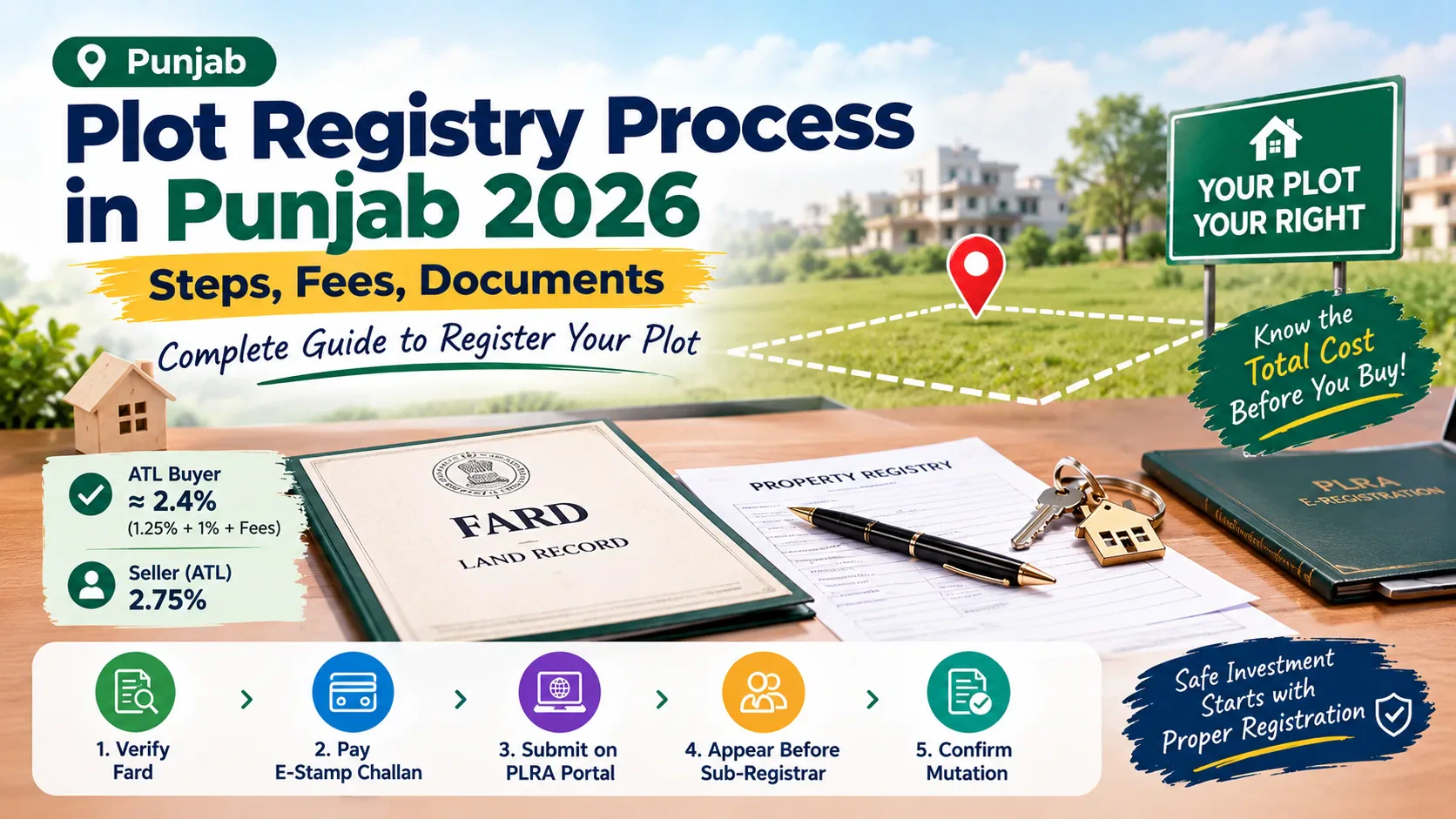
To register a plot in Punjab, check the Fard, pay the e-stamp challan, submit the request on PLRA’s e-Registration portal, appear before the Sub-Registrar with two witnesses, then confirm the mutation in your name. For a buyer on the Active Taxpayers List (ATL), government charges are about 2.4% of the plot value (1.25% advance tax + 1% stamp duty + small fees). The seller pays 2.75% advance tax. Other provinces and Islamabad use different offices and rates.
Registry is the legal sale deed, signed and recorded at the Sub-Registrar’s office.
Mutation (intiqal) updates the revenue record so the Fard shows you as the owner.
You need both to be fully protected.
Verify the plot. Get a fresh Fard from an Arazi Record Centre or online through Punjab Zameen. Check that the seller’s name matches the CNIC and that no mortgage or dispute is recorded. For a society plot, confirm the scheme is approved and get the society transfer letter and NOC.
Agree the sale in writing. Sign a sale agreement with the price, payment plan and handover date. Pay through bank channels, keep proof, and agree who pays which charge.
Check the values. Stamp duty is charged on the higher of your price or the DC value. Section 236K is charged on the FBR notified value if it is higher than the price. You can check the DC value before agreeing a price using the “Calculate DC Value” tool on the e-stamp portal.
Pay the e-stamp challan (32-A). It covers stamp duty, the registration charge and the PLRA fee. Pay at any Bank of Punjab branch or through a banking app. You can edit the challan only before paying, and it usually stays valid for about 90 days for one transaction.
Submit the request on the PLRA e-Registration portal (eregistration.punjab-zameen.gov.pk). For registries after 25 August 2026, the portal generates the 236C and 236K challans, so you do not use the FBR website.
Appear before the Sub-Registrar. Filing is online, but buyer, seller and two witnesses must attend in person with original CNICs. The deed is checked, approved and recorded.
Confirm the mutation. In online mouzas, the mutation is approved together with the registry. Elsewhere, apply for it yourself (ordinary, bank or express). Then collect the registered deed and the updated Fard showing you as owner.
Item | Amount |
Buyer advance tax (Section 236K) | 1.25% for ATL buyers. Non-ATL: 10.5% (up to Rs 50m), 14.5% (up to Rs 100m), 18.5% (above) |
Seller advance tax (Section 236C) | 2.75% for ATL sellers, 11.5% for non-ATL |
Stamp duty | 1% (urban and rural) |
Registration charge (extra stamp duty) | Rs 500 up to Rs 500,000 value; Rs 1,000 above |
E-registration service fee | 0.1% of value, minimum Rs 3,600 |
Mutation fee | Ordinary Rs 1,200, through banks Rs 2,100, express Rs 11,200 |
Fard or land record copy | Standard Rs 900, express Rs 4,000 |
Certified copy of registered deed | Rs 1,400 |
Property Transfer System (housing societies and authorities) | Rs 3,000 per transaction |
Sellers may also owe capital gains tax, which is separate. Housing societies add their own transfer fees.
Assumes the FBR value equals the price. Amounts in Rs. Mutation, society fees and legal costs are not included.
Item | Paid by | Both on ATL | Neither on ATL |
Section 236K | Buyer | 125,000 | 1,050,000 |
Stamp duty (1%) | Buyer | 100,000 | 100,000 |
Registration charge | Buyer | 1,000 | 1,000 |
E-registration fee (0.1%) | Agree who pays | 10,000 | 10,000 |
Buyer total | 236,000 | 1,161,000 | |
Section 236C | Seller | 275,000 | 1,150,000 |
Checking both ATL statuses before you pay any token money can save millions of rupees.
CNICs of buyer, seller and two witnesses
Latest Fard and the previous registry or allotment letter
Society transfer letter and NOC, if the plot is in a housing society
Paid e-stamp challan and the 236C and 236K challans
Active taxpayer status of both parties
Power of attorney verified by the Sub-Registrar, if someone signs for the owner
Paying the full amount before checking the Fard
Registering a plot in an unapproved scheme
Trusting photocopies instead of verified originals
Skipping mutation after registry
Paying a dealer in cash with no bank record
Writing a lower price on the deed (you still pay on the DC value, and it raises your later capital gain)
Is registry enough to prove ownership?
Registry is the legal sale deed, but complete the mutation too so the land record shows your name.
Can I register a plot without being present?
Yes, through a power of attorney, but it must be properly executed and verified by the Sub-Registrar.
Can overseas Pakistanis register a plot in Punjab?
Yes. The Sub-Registrar can have their statement recorded abroad through the Community Welfare Attaché at a Pakistani mission, with thumb impressions, photos and video.
Why does the tax differ from my sale price?
Stamp duty is charged on the higher of the price or DC value, and 236K on the FBR notified value if it is higher.
How much does plot registration cost in Punjab?
For an ATL buyer, about 2.4% of the plot value. On a Rs 10 million plot, that is roughly Rs 236,000 for the buyer and Rs 275,000 for the seller.
Where do I register online?
On PLRA’s e-Registration portal, eregistration.punjab-zameen.gov.pk. The similar-looking e-registration.punjab.gov.pk is a different, unrelated site.
Advertisement
Property Dealer Team
Property Expert
Experienced real estate professional sharing insights about Pakistan's property market.
October 20, 2026
Registry vs Intiqal in Pakistan, Key Differences...

October 19, 2026
Property Transfer Charges in Punjab 2026, Full Cost Guide...

October 19, 2026
Apna Ghar Scheme Online Registration 2026, Step by Step Guide...